
Every September the same thing happens in Perth. The mornings warm up, the evenings stretch out, the race calendar opens, and thousands of people quietly start training more. Not by decision — by circumstance. The ride goes longer because it’s pleasant. The run moves earlier because it’s light. The squad restarts because the pool is no longer miserable.
Then late October arrives and our clinic gets busy.
The people who come in are almost always surprised. They didn’t do anything reckless. They didn’t follow a stupid program. Most of them will tell you they were careful, and they’ll usually cite the rule everyone knows.
The 10% rule doesn’t hold up
Don’t increase your weekly mileage by more than 10%. It’s the most repeated piece of injury-prevention advice in endurance sport, and it has the great advantage of being easy to remember.
Researchers at the Hospital for Special Surgery tested it. They tracked 735 runners through 16 weeks of training for the 2019 New York City Marathon, using their actual Strava data rather than self-report. Forty per cent of them reported an injury over the block.
When they looked at who got hurt, exceeding the 10% rule was not associated with injury. The runners who avoided rapid increases did better — but the specific 10% threshold carried no predictive weight. The study also found injury risk was similar regardless of age, sex or body mass, which quietly demolishes the assumption that novices and older runners are the fragile ones.
So the rule isn’t dangerous. It’s just not doing the job people think it’s doing.
Neither does the model that replaced it
Here’s the part that surprises people who’ve moved on from the 10% rule to something more sophisticated.
For most of the last decade, the serious answer to load management has been the acute:chronic workload ratio — your recent training compared with your longer-term average, with a “sweet spot” you’re meant to stay inside. It’s the logic underneath the training-load screens on most sports watches and coaching platforms.
It has been taken apart fairly comprehensively. Impellizzeri and colleagues published a detailed critique of its conceptual and methodological problems in 2020, followed by a paper in Sports Medicine whose title leaves little ambiguity: time to dismiss the ACWR and its underlying theory. Separate work showed the calculation suffers from mathematical coupling — the same number appears on both sides of the ratio, which manufactures correlation that isn’t really there. The widely reproduced “sweet spot” figure was the subject of a formal retraction request to the British Journal of Sports Medicine, on the grounds that an illustration only ever intended as a rough guide had been republished repeatedly until it looked like settled science.
Results across studies have been inconsistent — some finding high ratios increase risk, some finding the opposite, some finding nothing.
None of that means training load is irrelevant. It means the tidy number you’ve been watching probably isn’t telling you what you think.
What does hold up
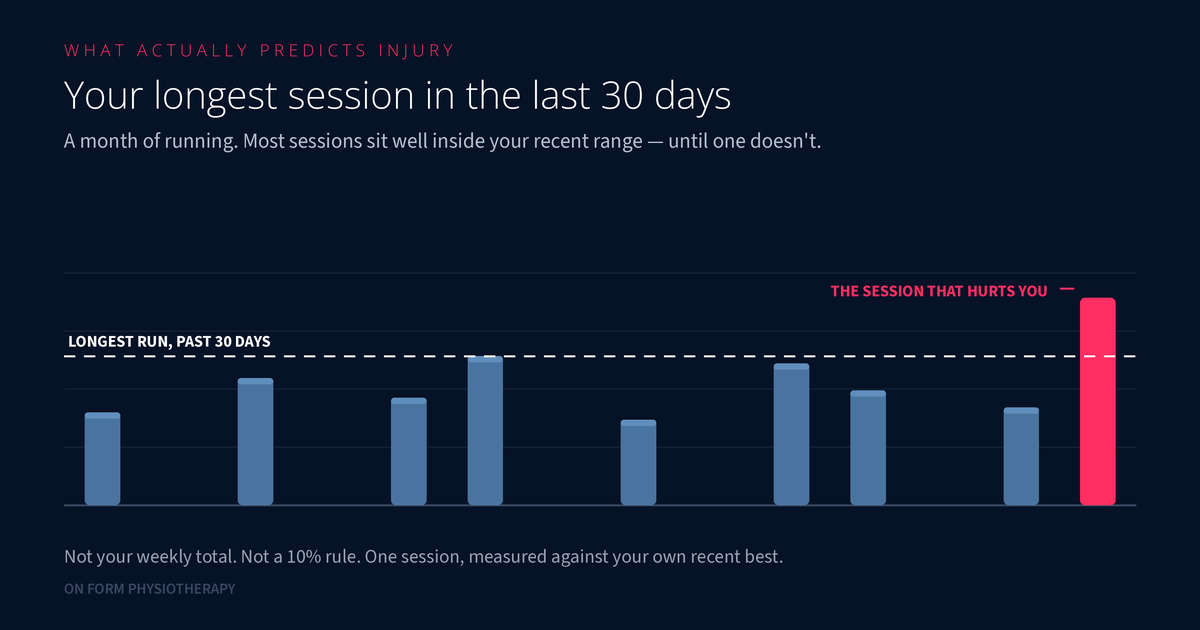
The most useful finding we have comes from the largest running study ever conducted. The Garmin-RUNSAFE study followed 5,205 runners across 87 countries for 18 months and captured 588,071 running sessions.
Weekly and fortnightly load metrics — the ones your watch uses — showed no clear relationship with injury. What did predict injury was far more specific: how far a single run went compared with your longest run in the previous 30 days.
Go 10–30% beyond that, and injury risk rose by roughly 64%. Push further and it climbed from there.
The conclusion the researchers drew is worth sitting with. Most running overuse injuries don’t accumulate slowly across a block. They happen in one session — and that session is usually identifiable in advance.
Why the bill arrives late
If the damage happens in one session, why does the pain turn up weeks later?
Because the different tissues in your leg adapt at very different rates, and none of them keep pace with your cardiovascular fitness. Your heart and lungs respond to training within days. Muscle adapts over weeks. Tendon and bone are considerably slower.
That mismatch is the whole problem. Three weeks into a spring build you feel fantastic — your aerobic system has caught up and you can hold paces that felt hard in July. Your tendons haven’t caught up. They’re still working through a load they were introduced to a fortnight ago.
So you feel ready, you train accordingly, and the tissue quietly falls behind. That gap is where October’s caseload comes from.
The multi-sport trap
For triathletes this gets worse, and it’s the specific reason September is so predictable.
Spring doesn’t increase one sport. It increases all of them, in the same fortnight, without anyone planning it. The swim squad restarts, the long ride gets longer, the run moves to daylight.
Each individual increase looks reasonable. A 15% swim increase, a 20% bike increase and a 10% run increase all sound defensible in isolation.
But your Achilles doesn’t file load by discipline. It experiences one total. And that total just went up by considerably more than any single number in your training diary suggests.
What to actually do
Compare against 30 days, not last week. Before any long session, ask what your longest equivalent session was in the past month. Keep the increase modest against that. This addresses the strongest predictor in the data, and it’s the single highest-value habit in this article.
Increase one sport per week. The runners who avoided rapid increases got injured less — it’s the speed of the change, not the size of the number. So if the bike goes up, hold the run and swim steady. This is the one that matters most in September, and almost nobody does it.
Build frequency before duration. Four shorter sessions beat two long ones while you’re re-establishing tolerance, particularly in swimming and running.
Treat the first four weeks of any build as the risky part. Not the peak weeks. The relative jumps are biggest when your baseline is lowest, which is exactly when you feel fresh and motivated.
Deal with existing niggles now. The strongest single predictor of a running injury is having had one. A niggle you’re managing in September is cheap. The same niggle in November costs you the race.
If it’s already sore
Most people’s instinct with a grumbling tendon is to stop. That instinct is understandable and it’s usually wrong.
Silbernagel and colleagues randomised patients with Achilles tendinopathy to either continue running and jumping using a pain-monitoring model, or rest from those activities for six weeks. The group that kept loading did just as well.
The rules they followed:
Pain may reach a set threshold during the session
Pain may reach that threshold immediately afterwards
Pain the following morning should not exceed it
Pain and stiffness must not increase from week to week
That last rule is the one people forget, and it’s the one that matters. A single session feeling fine tells you very little. The weekly trend tells you everything.
The original study allowed up to 5 out of 10. We use a more conservative 3 out of 10 in the clinic, because most recreational athletes are poor at rating their own pain honestly mid-session.
Complete rest settles the pain and reduces the tendon’s capacity at the same time. You come back to the same training load with less tissue than you had before, which is why so many people get the same injury twice.
When to get it looked at
Night pain. Weakness rather than soreness. Something that’s been there for months rather than days. A range of movement that keeps dropping despite backing off. Any of those, and this article isn’t the answer.
And if something’s been there for ten days and isn’t trending down, it isn’t settling on its own.
On Form Physiotherapy is Perth’s endurance sport clinic, in Rockingham and Yangebup. If you’re building through spring and something isn’t right, book an assessment or call (08) 6385 8029.
Sources
Toresdahl BG et al. Training patterns and injury in New York City Marathon runners. British Journal of Sports Medicine — HSS summary
Nielsen RØ et al. Garmin-RUNSAFE Running Health Study, Aarhus University — summary
Impellizzeri FM et al. Acute:chronic workload ratio: conceptual issues and fundamental pitfalls. IJSPP 2020;15:907–913
Impellizzeri FM et al. What role do chronic workloads play in the acute to chronic workload ratio? Time to dismiss ACWR and its underlying theory. Sports Medicine 2021;51:581–592
Silbernagel KG et al. Continued sports activity, using a pain-monitoring model, during rehabilitation in patients with Achilles tendinopathy. AJSM 2007